OUR AWARDS & PATENTS
With innovative multi-factor authentication (MFA) technologies and a Zero Trust framework, Keypasco has earned multiple international cybersecurity awards and holds patents in multiple countries, covering device fingerprinting, two-channel authentication, and risk assessment. Driven by R&D innovation, we deliver the most secure and forward-looking authentication solutions to customers worldwide.
Awards

2024 Cybersecurity Award

2022 SelectUSA Cybersecurity Winner

2018 Top 10 Managed Security Service Provider

2016 Red Herring Top 100 Europe Award

2016 CMA Contactless & Mobile Award

2014 APICTA Excellence Award in Finance
2014 Frost & Sullivan New Product Innovation Leadership Award
2024 資安精品獎

2022 SelectUSA 網路安全第一名
2018 年十大頂尖的資安託管服務商
2016 紅鯡魚全球科技創新大獎
2016 CMA 非接觸式與行動應用獎
2014 APICTA 金融類傑出表現獎
2014 Frost & Sullivan New Product Innovation Leadership Award
Our Patents
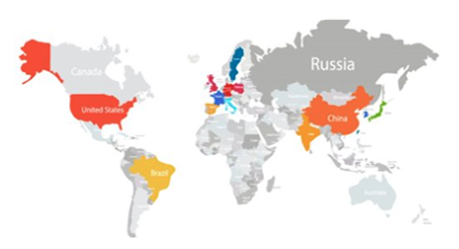
Keypasco holds 68 patents across 16 countries, including the U.S., Japan, Taiwan, South Korea, the EU, China, and Singapore. These patents cover core technologies such as device fingerprinting with two-channel authentication for stronger identity binding, proximity authentication for physical device security, central private key splitting to prevent misuse, and dynamic URL authentication paths for multi-tenant environments.
We also push forward passwordless adoption, enabling secure, trusted access without usernames or passwords.
Device Fingerprints & Two-Channel Authentication
Patent: Method for Verifying Identity via User Location
Patent Publication No. I531202

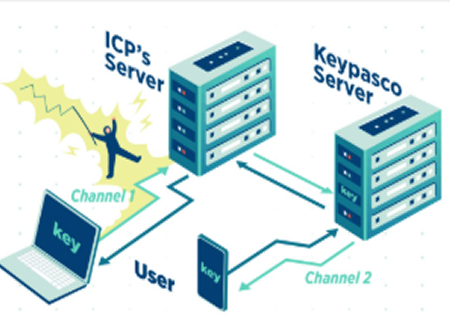
When logging in or performing sensitive transactions, Keypasco’s patented device fingerprinting identifies unique hardware/software traits to bind devices securely. Combined with two-channel authentication—linking a user’s registered devices such as phone and computer—this mechanism blocks unauthorized devices, phishing, and credential theft, providing an invisible yet robust defense.
Two-channel Structure
Device Fingerprints

Proximity Authentication
Patent: Network Security Authentication Method and Portable Electronic Device Authentication Method

Proximity authentication uses physical distance as a security factor. The user’s registered device (e.g., phone, wearable) must be near the login device, verified via Bluetooth, NFC, or ultrasound. This ensures both devices belong to the same user, blocking remote hijacking attempts—ideal for high-security MFA scenarios.

Centralized PKI with Private Key Splitting


This approach splits a private key into two halves—one stored securely on a central server, the other encrypted and stored in the user’s device app. Both must match during authentication, reducing key theft risks even if the device is lost or compromised.

Dynamic URL Authentication


Dynamic URL is a flexible and highly scalable authentication architecture that allows the same client or application to automatically route multiple ICPs (service providers) to multiple IDPs (identity providers) based on different service requirements. This design enables enterprises to easily integrate various authentication sources without having to develop a separate login process for each service, thereby improving deployment efficiency and operational flexibility. At the same time, the dynamic URL mechanism also facilitates multi-tenant, multi-brand, or cross-regional authentication needs, delivering a consistent and scalable secure login experience for enterprises.

Key Management System


Encrypted private keys are bound to a device’s unique fingerprint, preventing decryption or use on unauthorized devices. This stops key duplication, tampering, or misuse, ensuring the key’s authenticity and exclusivity.

Passwordless Login Environment
Patent: Method and System for Logging into an Online System Without Account Name and Password


In application environments where no specific account or password is required for login, authentication evolves toward true passwordless access. Users no longer need to remember complex account-password combinations; instead, they are securely authenticated and logged in through trusted devices, biometric verification, or certificate-based authentication. This approach not only greatly simplifies the login process and enhances user experience but also reduces cybersecurity risks caused by password leaks, reuse, or phishing attacks—making it a critical step toward achieving both security and convenience.

LATEST NEWS
Master cybersecurity trends to build a foundation of competitiveness
Keypasco at CyberSec Delhi Conference 2026: Connecting Industry Perspectives on Digital Trust
The Keypasco team at CyberSec Delhi Conference 2026. On 7 October 2026, Keypasco participated in the CyberSec Delhi Conference at Radisson Blu Plaza Hotel, Delhi Airport, India. The event brought together cybersecurity decision-makers, technology leaders, and industry professionals, providing opportunities to exchange perspectives on authentication and better understand business needs in the Indian market. From conversations at our booth to discussions throughout the conference, the event offered a valuable setting to explore how businesses can build digital trust while balancing security with ease of use. Bringing Security and Ease of Use Together At the Keypasco booth, we shared how a range of authentication factors can help businesses address security and usability together. Authentication is an important part of the interaction between users and digital services. Businesses need to consider how users can complete their tasks smoothly while maintaining appropriate protection. That balance depends on the needs of the organisation and the context in which its services are used. Our conversations with visitors provided opportunities to exchange practical perspectives and listen to the priorities of businesses in India. They also created space to explore potential areas of collaboration around authentication and digital services. A Keypasco representative discusses authentication applications with a visitor. Face-to-face conversations offered opportunities to understand business needs and exchange perspectives on authentication. Considering Cybersecurity Through the Resilience of Essential Services The conference addressed the resilience of India’s essential services in the face of emerging threats, with discussions spanning power, defence, manufacturing, and industrial ecosystems. These sessions offered perspectives on the challenges facing different sectors and encouraged participants to exchange their approaches to cybersecurity. The discussions reinforced the value of considering security within the wider context of business operations and service continuity. Different industries have different operating environments and user needs. Authentication should respond to those practical requirements and support secure, convenient digital interactions. For Keypasco, the conference provided useful perspectives on India’s cybersecurity landscape and an opportunity to consider how authentication can support businesses as they build digital trust. Conference discussions addressed the resilience of essential services in the face of emerging threats. Continuing the Conversations Beyond the Conference CyberSec Delhi Conference created opportunities for exhibitors and industry professionals to connect face to face. Each interaction was a chance to understand business needs, exchange experience, and build relationships. We thank the CyberSec India Expo team and everyone who visited the Keypasco booth. We look forward to continuing these conversations and exploring future collaboration toward safer, simpler digital experiences. Contact the Keypasco team to discuss your authentication needs.
Keypasco in The Hague: From Digital Trust in the AI Era to International Exchange and Cooperation
During 6–8 October 2026, Keypasco participated in ONE Conference 2026, the ONE International Cyber Business Event and SECPAAS Cyber Taiwan B2B Matchmaking in The Hague, the Netherlands. Through presentations, a panel discussion, exhibition conversations and one-to-one business meetings, our team shared perspectives on identity security with the international cybersecurity community and explored opportunities for cooperation between Taiwan and the Netherlands. At the heart of our visit was the question of how to put digital trust into practice. As people, devices and AI agents work together in enterprise processes, organisations need to verify identities, recognise devices and clarify the authorisation and accountability behind each action. The Keypasco team connects with visitors at ONE Conference 2026. In the AI Era, Every Action Needs a Trusted Basis ONE Conference 2026 took place on 6–7 October at World Forum in The Hague. During the event, Keypasco’s Chengi Lin presented “Trust infrastructure for the AI era,” sharing an approach to identity security that encompasses people, devices and AI agents. The presentation began with three questions: Human: Who is requesting access? Device: Can this device be trusted? AI agent: Who authorised this action? These questions address identity verification, device fingerprints and access context, as well as AI agent delegation, policies and auditability. When AI agents begin carrying out tasks on behalf of users, organisations need to understand the user's intent, the permissions granted to the agent and the actions it actually performs. Clearly connecting these relationships provides a verifiable basis for access control, authorisation management and accountability. Chengi Lin presents trust infrastructure for the AI era. Exploring Secure Edge AI Deployment from Different Technical Perspectives Chengi Lin also joined “Securing Edge AI: From Trusted Hardware to Real-World Deployment,” discussing the security challenges of moving Edge AI from trusted hardware into practical deployment with industry experts. Moderated by Wei-Bin Lee, CEO of the Hon Hai Research Institute, the panel brought together experts from NXP Semiconductors, TNO, Synology, ASRock Industrial and Keypasco, contributing perspectives from semiconductors, applied cryptography, systems technology and identity security. For Keypasco, the discussion offered an opportunity to contribute the identity and authorisation perspective. As AI capabilities become part of connected devices and operational environments, deployment must clearly define which entities can be trusted and what each is permitted to do. The Edge AI panel brings together perspectives from different technical disciplines. Chengi Lin shares the identity and authorisation perspective during the panel. At our stand, the Keypasco team continued conversations with visitors about authentication, zero trust and the permission boundaries governing AI-driven actions, connecting the ideas presented on stage with practical business needs. Participants at an exchange event alongside ONE Conference. International Business Exchange: Building Connections and Understanding Markets On 6 October, Keypasco participated in the ONE International Cyber Business Event at Leonardo Royal Hotel Den Haag Promenade in The Hague. Organised by InnovationQuarter, the Municipality of The Hague and The Hague & Partners, the event brought together international cybersecurity leaders, Dutch entrepreneurs, startups and scale-ups, providing opportunities for cross-border industry exchange. Through business networking, Keypasco extended the technical themes of our visit into discussions about market needs and potential cooperation. Connecting with participants from different backgrounds also provided a starting point for further dialogue. B2B Matchmaking: Bringing Greater Focus to Cooperation On 8 October, Keypasco participated in SECPAAS Cyber Taiwan B2B Matchmaking at HSD Campus, meeting participants from the Netherlands for one-to-one discussions. These individual meetings gave our team an opportunity to introduce our approach to authentication and zero trust, listen to business needs and develop a more specific understanding of each other's concerns and priorities. One-to-one discussions at SECPAAS Cyber Taiwan B2B Matchmaking. For Keypasco, the value of B2B matchmaking lies in bringing technical exchange closer to real-world applications. Face-to-face conversations help both sides clarify requirements and potential areas of cooperation, establishing a basis for further discussion. From the connections made at the international business event to the focused discussions during B2B matchmaking, our visit also gave Keypasco an opportunity to contribute to continued exchange between the cybersecurity industries of Taiwan and the Netherlands. Participants at SECPAAS Cyber Taiwan B2B Matchmaking. Taking the Conversations in The Hague Forward Thank you to the event organisers, SECPAAS–Cyber Taiwan, the Taiwan delegation, our fellow panellists and everyone who connected with Keypasco. Our visit to The Hague connected technical discussions about identity security with international business exchange. Keypasco looks forward to continuing these conversations and exploring opportunities with enterprises and industry partners to establish clearer, verifiable trust relationships across the digital interactions of people, devices and AI agents. Contact Keypasco to discuss your authentication, device trust and AI authorisation needs, or explore opportunities for cooperation.
2026 Keypasco Summit: Advancing AI Governance Through Identity and Trust
As AI agents take on business tasks, access sensitive data, and act across enterprise systems, organizations face a new set of questions: Which agent is taking action? Who authorized it? What is it allowed to do—and how can the organization intervene when something goes wrong? Opening remarks at the 2026 Keypasco Summit, highlighting identity security and trust governance in the era of autonomous AI. These questions shaped the conversation at the 2026 Keypasco Summit, held on September 22 at W Taipei. Co-hosted by Keypasco and TechOrange, the AI Trust Governance Forum focused on helping enterprises move AI from pilot projects into everyday operations through agent identity, device trust, and continuous verification. Explore the event. Enterprise technology and security leaders gather at the 2026 Keypasco Summit to explore AI trust governance. Bringing the AI Governance Community Together The Summit brought enterprise technology and security leaders together with international partners from Japan, Australia, Sweden, Spain, Jordan, Vietnam, and India. Inside the conference hall, attendees followed presentations framed by a row of national flags, reflecting the international reach of the gathering. Beyond the main stage, the exhibition area provided space for closer conversations. Visitors gathered around demonstration screens, spoke with technical teams, and explored identity security and governance solutions. These exchanges connected the broader discussion of AI governance with practical implementation questions: how authentication fits into existing workflows, where access controls need to evolve, and what organizations must put in place before giving agents greater autonomy. For Keypasco, the Summit created an opportunity to bring enterprise needs, technology development, and international experience into the same conversation. Attendees speak with technical teams in the exhibition area to explore identity security and governance solutions. Establishing Clear Boundaries for AI Agents AI agents can plan tasks and use tools with increasing independence. As organizations connect them to business systems, however, excessive permissions, prompt injection, and incomplete audit trails can introduce risks directly into operational workflows. In his opening remarks, Keypasco Chairman Cheng-I Lin highlighted trust as a critical barrier to bringing AI into core business operations. When agents gain access to ERP or CRM systems—or the authority to execute transactions—organizations need clear answers about identity, authorization, and accountability. This makes agent identity an essential part of AI governance. Enterprises need to understand which agent is acting, whose authority it carries, and which actions fall within its mandate. They also need a reliable way to investigate unexpected behavior and intervene when necessary. AI governance spans data management, model risk, organizational policy, and human oversight. Keypasco’s contribution builds on its experience in identity security, providing a technical foundation for putting governance requirements into practice. A New Solution Direction: The Trust Identity Platform At the Summit, Keypasco outlined its continued expansion from multi-factor authentication into broader trust governance through the development of its Trust Identity Platform. The platform’s direction brings people, devices, and AI agents into a shared trust framework. Its goal is to give autonomous actors digital identities that organizations can recognize, authorize, manage, track, and audit. Three priorities help explain how this approach supports enterprise AI adoption. Agent identity establishes accountability.Organizations need to distinguish one agent from another and connect each agent to its authorization source and responsible business owner. This creates a clearer basis for managing delegated authority. Device trust adds context to access decisions.Identity alone does not provide the full picture. Enterprises also need to assess the devices and environments from which access requests originate and determine whether they meet the organization’s security requirements. Continuous verification supports ongoing control.An agent may access different resources and invoke multiple tools while completing a task. Governance therefore needs to remain active throughout execution, supported by records that enable review and investigation. Consider a customer service agent authorized to check order information. Its access should be limited to the data and actions required for that task. Refunds or bulk data exports may require additional review, depending on the organization’s risk policies. This example illustrates how governance can support useful automation while preserving control over sensitive actions. It also shows why agent identity must connect with authorization policies and operational oversight. Learning From Enterprise Practice and International Partners The Summit explored these challenges from several perspectives, including organizational workflows, financial applications, and the transition from automation to greater autonomy. Keypasco CTO Chia-Hsien Chang presented a next-generation identity governance architecture and advocated a shift from one-time access reviews toward continuous, dynamic verification. This direction addresses the reality of agents that operate over extended periods and move between systems as they complete tasks. Japan’s Dai Nippon Printing (DNP) shared its experience combining zero trust and trust governance in a large enterprise environment. A closing panel brought together representatives from Keypasco, DNP, Keycyber, JoEagle, and Auspac One to discuss what it takes to move AI agents into core business operations. Across these discussions, a common theme emerged: identity verification, access control, and auditability need to work together. Effective deployment also requires technology to align with business processes, internal policies, and clearly assigned responsibilities. By connecting international partners through the Summit, Keypasco is creating opportunities to draw on practical experience from different markets as its solutions continue to develop. International partners discuss the governance requirements for bringing AI agents into enterprise operations. Building the Trust Needed to Scale AI The 2026 Keypasco Summit reflected Keypasco’s ongoing commitment to AI governance and the identity infrastructure that supports it. Agent identity, device trust, continuous verification, and auditability provide a practical starting point for organizations preparing to give AI a larger role in their operations. Together, they help enterprises establish clear authorization boundaries and maintain accountability as autonomous systems become more capable. Keypasco will continue working with its global partners to advance the Trust Identity Platform and its real-world applications. For enterprises, the path forward begins with a clear understanding of every actor, every permission, and every action. With that foundation in place, AI can become a more dependable part of everyday business.
Strengthen Your Identity Authentication Now
Elevate Enterprise Security Like Never Before
Keypasco is delighted to share more about our exclusive technologies and products with you! Tell us your needs and goals, and let Keypasco deliver the most suitable solution—becoming your dedicated identity authentication technology advisor.
如果您想問技術相關問題 請點我